Passion, obsession, feigned ambivalence

My friend messaged me this philosophy she was reading about. She said, “the key to succeeding is to want something, but not so much that you obsess over it”

This ideas has been haunting me all week. At Sunday practice I was doing an endurance drill with a teammate. She was killing it and I told her so.

“It’s because they’re all pacing themselves,” she said.

“Why would they pace themselves? It’s a 2-minute drill.” I asked.

“Everyone does,” she said.

“I don’t,” I said. “I just do the best I can and usually by the time I’m tired, so is everyone else.”

These two ideas have been battling in my mind. So when that friend messaged me with her idea, I disagreed with her. “If you want something, I don’t think you should feign ambivalence. I think you should hunt your goal, not be coy. And if you’re disappointed, you’re disappointed, but at least you gave it everything. Way better than pretending you don’t care, being disappointed, then wondering if you could have done better,” I said. But, I buffered, “that’s me and I’m cray.”

As home team draft approaches, I am seeing a lot of my friend’s philosophy. Some of my teammates say things like, “I probably won’t get drafted and I don’t want to be disappointed, so I’m just trying not to care.”

It saddens me. These are hard-working women who love the sport. Isn’t this the time to go balls out? I think it’s time to show how much you want it and how much derby means to you and how hard you will try.

But, then there is my reasonable friend who said, it’s just about not unhealthily obsessing.

True. So how do we find a balance where your heart isn’t in a grinder if you don’t achieve your goal, but also giving your goal everything you can?

As another former teammate of mine said, a healthy level of participation in derby is 7.

She meant out of 10.

For me, that means eating well, going to my practices and giving it everything I have in that time that I have and then crosstraining. It also means I have to go to movies, spend time with my loved ones and go to work.

It’s a hard balance in derby land and I wonder: Is it ever OK to be a 10? What about in the final jam, overtime in a tied game? During home team drafts? Travel team tryouts? Endurance practice? When should you be a 10? (Answers and input welcome in the comments)

Derby resolutions

Lots of people are resolving to be skinny right about now. I’m not one of them. Being skinny doesn’t help you be a muscley roller derby warrior like I want to be.

Last year I resolved to get strong and fast. It was pretty much the same one as in January 2011, when I found roller derby.

But, that saying is true: It doesn’t get easier, you just get better/stronger.

I don’t like abstract goals — immeasurable — like “get stronger and faster.”

I argue this isn’t. In January 2011 I think I could maaaaaaybe have made 25 laps in 5 minutes. This past year I made 32 laps (maybe it was 34. Honestly can’t remember) in five minutes. With that endurance, I went to Rose City Rollers to skate and was exhausted after my first endurance practice. I don’t get that tired anymore. I don’t fight to keep up — I fight to push myself now. (I haven’t times my laps since June). So, it’s not immeasurable. I am a faster me.

My thighs don’t fit into my old pants. My belly went from a little round to flat to weirdly jutting out (abs) a bit. I did 100 pushups yesterday, 10 minutes of planks, 5 minutes of crunches while watching a bout. Last year I couldn’t do 50 pushups without taking a day. I’m a stronger me.

To make it more concrete, here are some subgoals for 2013:

-Make the B team roster
-Become an integral part of my home team
-Find the volunteer job in my league where I can do the most good
-Work on arm control so that my upper body is helping, not hurting my form and stride.
-Crosstrain at least twice a week (ideally plyo for footwork)

I’d love to hear your derby goals for 2013 in the comments.

People in the North East: Go to this

Last year I heard about a new derby convention, the Northeast Derby Convention. My friends and I decided to go because it was near us and pretty cheap, but had some amazing skaters as instructors.

It was game-changing. For our entire league. (NE Derby Con doesn’t pay me. I get no swag or anything for writing this.) Ten players on my league in Maine decided to go. It cost about $150 a pop for a three-day pass. The training we got there was undoubtedly the reason that same little, newly-founded league won our New England B-team tournament a few months later.

Photo by Northeast Derby Convention. (I was paying attention to something awesome.)
Photo by Northeast Derby Convention.
(I was paying attention to something awesome.)

You need to go. It’s again $150 and it’s three days. Not many more details are available on the website yet, but let me tell you what I got last year: 21 hours on skates training. Yeah. 21. I took one off skates session too, so I think it was 22 hours total. For $150. A little math says that’s about $7 to learn jam tips from Suzy, $7 to learn to be a badass from Demanda, $7 to learn new pack strategy from Quadzilla, $7 for Teflon Donna to show you how to mohawk around people, $7 for Bonnie D Stoir to give you the puppy talk (look it up), $7 for Smarty Pants to hit you backward. I mean. Come on. You paid more for the leggings in your closet when you made fresh meat.

That doesn’t include the parties, the hang out time between sessions, the scrimmages, etc etc etc. It’s the best money I’ve spent in a while and elevated my play and my leaguemates play.

Last year the convention was set up as one-hour blocks of sessions with 30 minute breaks in between. That’s 30 minutes to digest, take notes and practice the skills you learned. Oh and rest, right. Those one-hour sessions aren’t going to be the time you need to perfect skills, but I found that my notes from last year still come in handy — because 21 hours is a lot to digest.

The other awesome thing about the sessions on-skates was that they were divided into levels: basic, home team, intermediate, elite. That meant the stars of the Boston Massacre weren’t intimidating the fresh meat from the new Vermont league and let everyone play comfortably and get what they needed from their skate time.

For the nonskaters (and skaters) they also had classes on league structure, how to evaluate skaters, etc. Super helpful for the little leagues trying to figure out the basics of derby business.

So that’s my ringing endorsement. If I were still on the East Coast, I’d be there in a heartbeat. It’s the most one-on-one time you’re going to get and it’s with the best skaters in the world today.

Information: http://www.derbyconvention.com/register.html

The difference between fresh meat and not

My league just got a new round of fresh meat. I played with them and watched them play at scrimmage yesterday. There is the one huge difference between the new fresh meat and everyone else.

Sally is a veteran skater. She puts on the jammer panty. The whistle blows and she gets past three blockers, easy. The last line of defense comes at her. Sally sees the blocker and leans into the hit, trying to gain control by putting her own leg in front of the opposing blocker. She gives her weight to the blocker and then runs off. She then gets 50 points in a jam, wins the scrimmage, gets drafted to away team, wins MVP, goes to nationals, Team USA, wins the world, the end.

Then there is fresh meat Fran. Same situation. Fran takes the jammer panty. The whistle blows and she gets past the first three blockers. Then she sees the last line of defense blocker. The blocker looks at Fran. Fran looks at the blocker. And Fran’s face instantly says, “You are going to hit me and I am going to fall and it might hurt and I might break my leg and never play derby again. Shit.” Then, like Fran’s face predicted, the blocker hits her (as blockers do) and she falls and gets recycled to the back of the pack and has to do it all again while Sally (what a bitch) scores a billion points and gets on Team USA instantly. (Bitch.)

Skaters who see another blocker as an inevitable hit that they can’t take — they’re right. Skaters who see another blocker as a quick obstacle to take on before skating off — they’re right too.

One skater I like told me and my teammates, “when I’m on the track I say to myself that I’m the biggest badass on that track. You know how many times I’m actually the biggest badass?” And she laughed. But that mindset matters. It has to change from “You’re going to hit me” to “Just try to hit me.”

New rules, new patience.

I can’t talk about the new WFTDA rules because they’re not publicly out until Monday. But we know changes are coming. By changing the rules, WFTDA is changing the way you’re going to play. (If you’re the jerk screaming “I WON’T CHANGE” you’re the jerk in the box. Six times. Then the jerk without a jersey. Probably.)

This is where the mind strength is going to come in. Especially for those people who are out there, bouting and scrimmaging. It will be hard. People who are not used to going to the box will. People who are used to going to the box will more.

This is where that last energy post comes in.

It’s where we need to remember how to treat ourselves: Like learners. If you’re trying to teach someone something, does it help to bark at them and be mean and demoralize them? No. So, when you’re in the box because you haven’t learned the new rules and how to apply them perfectly, remember that. It’s going to take time to teach yourself, so be kind.

It’s hard. It’s really fucking hard. I know.

Denver v. Texas in the WFTDA Camphionships

I told my friend at practice that I made a video of me reacting to the last jam of Denver/Texas. I said I had been screaming at my screen all day during the WFTDA championships, but that that last jam made me go silent. This, I thought, made it not as interesting as “things a derby girl screams while watching a bout” — she assured me, it might be. So, here it is:

How to make a bout, a guide

“Dash, you haven’t updated your blog in days, wtf.”

You ever think it’s because I was working on something EPIC?

Coming to this blog, soon, will be a new page about how to make a bout. It’s a guide for small leagues around the nation who aren’t sure how to get rolling. There are lots of these little leagues popping up and I know I would have appreciated the help as the bout production manager of my last league, which was about a year old and totally bout-making inexperienced.

So. Here. I present you with a draft version of “How to Make a Bout” — a new page on the Dashboard, which will likely be one of many new pages on derby topics. Because this is a draft, I’m asking for feedback. In the comments below, please add your own tips, comments, advice, etc. I wrote this from a Bout Production Committee standpoint, not a league-wide — but that might come in the future, as I gain experience and feedback. So here it is, peeps. Feedback appreciated.

— Dash

Preface: When I stepped up as bout production manager for my [then-]small, [then-]new league in Maine I couldn’t find a comprehensive “how to make a bout” guide. Then I made four bouts anyway, with the help of two other committee members. So now, a veteran of small-town, new-to-this bout production, I wanted to give back. Here is what I learned. Here is how I did it. This worked for my league (we brought in about 2,000 people per bout for four home bouts — in a town of 3,000 people — and kept ticket prices at $5 a person and free for kids.). It might not work for yours. Take what works and ditch what doesn’t. But at least now there is something on the Internet to help.

The BP rule: My bout production committee (hereafter: BP … aka best people) had only one rule: Don’t freak out. To be on BP you had to adhere to our sole rule: Don’t freak out. Ever.

So, new BP person, don’t freak out.

What helped me not freak out is this: When it comes down to it — when it really really comes down to it all you need is rope and tape. Everything else is glitter. (Read that again if you have trouble adhering to the rule of BP.)

The committee: On my BP we had me, a co-chair (heavy responsibility) and two droogs. Droogs are task-doers. They would each take one smaller task a week up to bout week (like researching the cheapest, best tapes. Or making rinkside seating signs and having them printed. Or buying dry erase markers for the NSO white boards.). On bout day they were go-to people. I would say this was enough for our small league, but the more droogs the better. Pick one person on the committee who will communicate weekly with the other committee heads and get brief reports. We met once a week, starting six weeks before a bout. The BP chair always bought a pitcher of beer. It ensured attendance.
One thing that made tasks easier for BP was to have two large bins in the league lockerroom where people could put their BP items (like those signs, sponsorship committee’s bout-day banners, credit card-takers, tape, rope, etc.). This allows you to take inventory whenever you want and for others to be able to complete tasks without having to find a certain skater.

BP responsibilities: Find out what your league expects from BP. In my league, BP was very dependent on other committees (yours likely will be too), so make sure your league is all on the same page about who-does-what. For instance, does BP make and print the bout flyers? The programs? The posters? Or is that the public relations committee? Does BP get white boards and markers for NSOs and whistles for refs, or does training committee? Know this stuff.

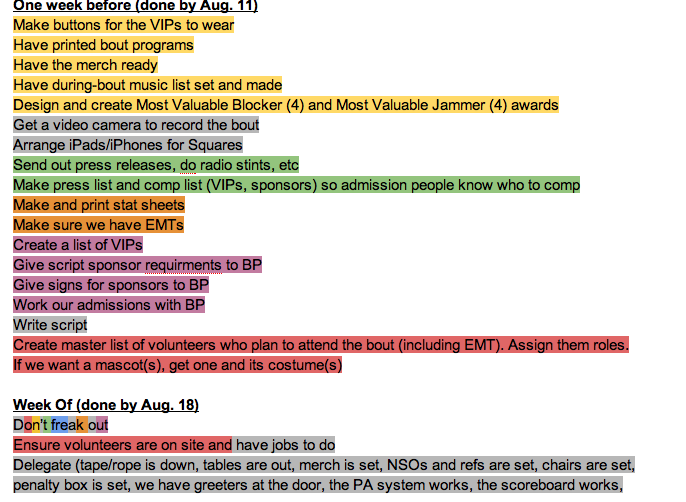
Delegation: BP’s primary responsibility (according to me … talk to your league) is delegation. Your league is full of busy people. If you plan to assign these busy people tasks, they will need ample notice of their responsibilities. So your first duty is to make a bout master list. I hope you like color-coding. To make a bout master list, title it with the bout date. Then make headers for the due dates. I started with 6 weeks out, then 5, 4, 3, 2, week before, three days before, day before, day of deadlines. (Bored yet?) OK, then fill in things you need done. Once you’ve done that, add each committee name to the top of the document and pick a color for it. Put it in that color and then put all the tasks in the correct colors. Here is an example of a bout master list I made.  (<That is probably the most valuable piece of information on this page.) Once you have the master list and share it with everyone on the league, make sure you have someone on your committee who is dedicated to asking the committee heads where they’re at and what they have accomplished each week. This person should also send reminders of what deadlines are upcoming to each committee. One email a week would do it, “Hey training, How are you? Just wondering if you finished task A, B, C. I also wanted to remind you tasks D, E and F are coming up. Thank you!” or the like.
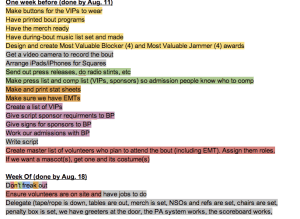
An example of a color-coded Bout Master List. (See link for full details)

That’s most of what BP is: organizing and delegating. Until the day of. More on that later.

Tape/rope: My league had to work in certain perimeters and certain budgets. We bought one rope and it lasted all season and I would bet it would last at least four more seasons, maybe longer. It was 1/4-inch yellow polypro rope and it was $20 for 400ft. You will need about 400 feet of rope that’s between 1/2 and 2 inches, as outlined by WFTDA. Tape was more difficult because our venue put some restrictions on us. We settled on buying blue, 2-inch-wide painters tape. Your tape will need to be 1-3-inches wide and a color that contrasts your floor. The cheapest place I found this was at Home Depot, sold in 6-packs. Painters tape comes in 60-yard rolls. Unlike the 400 feet of rope, you need at least double that (for laying below and above the rope) plus even more for fix-ups, so the 1,080-feet of tape from the 6-pack should be enough, but frankly, you can never have enough tape. Just save your receipts so you can return it — or use it for your next bout. Painter’s tape is NOT my first choice of tape. It rips. One time we did not properly stomp it down and in warm-ups on bout day we ripped up half the track by accident.
On one occasion, we held a double-header and knew painters tape would not cut it, and we got permission to use the coveted gaffers. Gaffers tape is the best. It’s cloth-like. It holds up a billion times better than painters, but doesn’t have the guckiness of ducttape. I bought mine in red from the Good Buy Guys (they don’t pay me to say that) because they were the cheapest. I got my tape a couple days later. I wanted to save my league money, so we taped down the first round (under the rope) with painter’s tape, then we put the rope down and then topped it with the more expensive gaffers tape.  If you get 2-inch gaffers, you will need three rolls (if they’re 55-yards), assuming you do the painters>rope>gaffers setup. It will set you back about $45 plus shipping and plus about three rolls of painters tape. Tape is expensive. It was my biggest expense for BP by far.
Lastly, you need some other-color tape (not the same color as your track boundary) for the jammer line, the pivot line and the 10-foot lines. You also want more tape for the 10-foot boundary required by WFTDA.

Shopping list: 400 feet rope (1/2 inch), 800+ feet of 1-3-inch-wide tape for track boundary, other-color tape for jammer/pivot/10-foot lines, other tape for 10-foot boundary.

Enough about tape? Yeah, you’ll be a tape ninja when you’re done. But remember what I said? All you really need is rope and tape. One last item though, I told my league’s sponsorship committee that tape was costing us about $100 and they found a local tree-trunk-grinding service to sponsor it, in full! They got a couple shout outs from the announcer at the bout.

Track set up: I’m not going to write about track layout. WFTDA gives comprehensive instructions and a hundred other blogs have already written about this. Just Google it. I don’t have any track layout magic for you. Just have lots of chalk and at least a 100-foot-measuring tape.
One thing to consider as a BP member though, is the set up of the track in relation to your venue. What setup will allow the most people to get a great view? What setup will be safest for referees? What will be easiest for the skaters? Where will “vendor village” be and how will people travel to the “village” and to their seat? Should you make foot traffic move around vendor village, the track, in front of other audience members? How does it relate to lighting? To the announcer?
People like sitting right behind skaters, if safe and if possible. Skaters like sitting right in front of the pivot and jammer lines (and WFTDA recommends you put team benches close to those lines) and to the penalty box. Skaters like to see the penalty board. Refs like 10-foot boundaries (usually) even when a 5-foot boundary would do, by WFTDA rules. Refs like to see NSOs and NSOs like to see the score keeper. You need to account for all of these things, plus traffic flow to the bathrooms, concessions and parking lot. Talk about this a lot beforehand with BP and make drawings, take measurements of your space, try things out.

Train: One thing guaranteed to make bout day easier is having your whole committee knowledgeable on all the “this can go wrong” stuff. Everyone on BP (assuming it’s a small committee) should know how the sound system, lights and scoreboard works. Ideally, your league will have a HR sort of committee that will organize and train volunteers ahead of time, but it’s nice to have several knowledgeable people available when things hit the fan. Of course, your volunteers should know the lighting plan, your NSOs should know how to use the scoreboard, your announcer should know how to use the microphone and your DJ should know how the music works, but BP needs to know how the microphone and the music interact. You need to know how the lighting interacts with the script/announcer, etc. Do a “dress rehearsal.”

Plan: Make sure to send the day of schedule to the other team and to your team with plenty of notice, and then let other committees know how things break down on the big day. Of course, other committees can refer to the Bout Day Master Plan, but it’s nice to reaffirm with an hour-by-hour plan, if possible. For instance, when should sponsorship hang the banners and where? When can refs warm up? When will the announcer have to do a run-through of the sound system? When do you need volunteers to set up admissions table? When do they need to staff those tables? Etc. Getting everyone on the same page and same schedule is immensely helpful. People are usually giving of their time, so long as you don’t waste it. Having a list of tasks that need to be completed helps with that.

Sleep well the night before. If possible. Don’t freak out. If you’re prone to freaking out: 1. Don’t 2. Keep paper and pen by your bed so you can write down the last-minute tasks you must do that you’re having nightmares about.

— Bout day —

Preparation: Don’t freak out. On bout day, if you are the one everyone is looking to, you need to be the calmest and the most collected. Bring enough food to get you through until late (like after-party late). I like to keep my Dash[clip]board with me with lots of pens, paper and some money. Wear something that stands out, like something with your name on the back and a colorful flourish, so people can say, “Yes, Dash is over there with the gold headband and yellow neckerchief” to aimless (no!) volunteers. Wear something with pockets. Don’t freak out. If you start to get overwhelmed, write down the tasks that need to be completed on your clipboard and begin delegating them. This is not the time to be a control freak, this is the time to rely on your leaguemates who are smart women too. And volunteers.

Admissions: You and your team should have a plan in place. Your BP team should also be ready to have your plan fail and be ready to make last-minute changes and decisions. For instance, at the first bout my last league did, we thought we could contain our admission to one table and three volunteers (one for cash sales, one for credit cards, one for counting heads. Sponsorship committee sent another volunteer to meet VIPs). We thought we’d have 200 or so guests. When 2,000 lined up out the door, out the parking lot and down the street, we had to adjust our plan. We added another table and three more volunteers. At the following bouts we had three tables (advanced sales, buy them now sales, VIP) and each had two volunteers, plus two (total) headcounters = 8, plus a volunteer wrangler. Two of those volunteers were trained on Square, a free device that takes credit cards by just using your iphone or ipad (they don’t pay me to say nice things either). Square takes 2.75% of your sale, so on a $5 ticket, you actually reap about $4.86. It’s about a $7 loss for every 50 tickets sold. For my league, that was worth it — maybe you lose two customers ($10) because they didn’t bring their cash and an ATM is too far away.
Another great tools for pre-sales was Brown Paper Tickets (no one is paying me for anything, to be clear). They have the ability to put their fees onto the customer, so your league reaps all the cash. It means online buyers pay about $1.80 more per ticket. They give you a “will call” list that you print out and keep at the door. I suggest doing this early in the day and editing it down to just names (not addresses, ticket numbers, yadda yadda).
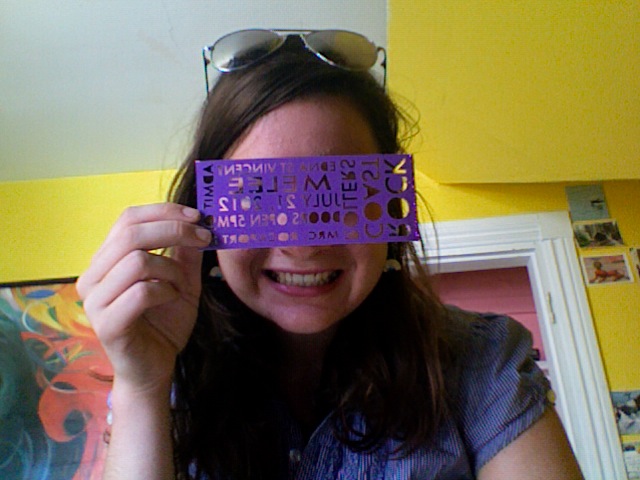
Lastly, we utilized the skills of one of our derby girls who is an artist to make tickets. She would make 300 for each event and we would sell them at local retailers. We KNEW this would be a money-spender, not a money-maker, but it got local businesses involved, got a lot of talk going in the community, increased our visibility AND, an added perk was that they were such beautiful tickets, some people bought them just to have them. We sold extras as keepsakes at the merch table on bout day. Here is a picture of a ticket example (it was a purple cutout and had purple glitter on one edge): 

An assortment of tickets for one bout. The artist (Yellow Bird & Co) made lots of colors for this one bout. People loved it and requested certain colors.

Announcers and the script: Starting with announcers: If you have one, great. If you don’t, the best option would be a trained announcer. The Association of Flat Track Derby Announcers has a list of them. If that doesn’t work, try looking for potential talent from other sports in your area. Try the local theater. Try open mic nights (comedians can make great announcers so long as they know your league’s expectations: is your bout family friendly? Do you want him/her to joke about sexy ladies hitting each other or for the announcer to be an ambassador of derby as a sport? Etc.). Ask your league if they know someone who would be good. If it’s a new person, my old league found it was helpful to 1. Train the new announcer at scrimmage practices 2. Pair the new announcer with a non-skating player at the bout. For instance, if you have a knowledgeable player who is out on an injury  — and if she can agree to call the bout fairly and not “coach” it over the microphone — this could add strategy knowledge to your announcing.
The script is a lot like an outline. It has a list of sponsor shoutouts with the correct information, the team rosters with names and numbers, sample wording for the “how derby is played” demo (if necessary — depends on announcer’s experience), wording about the halftime shows, wording about the league and future events. It’s helpful to have the mandatory shoutouts and the rosters on separate pages for the announcer(s) to quickly flip to. Talk to your announcer about what s/he wants from you.

Halftime: I’m not going to spend much time on this because you can find helpful tips on this elsewhere. But here are some tips: Halftime shows keep people. They keep them entertained, sitting, eating, consuming, watching derby. They’re important. They’re important for another reason: ticket sales. When thinking about what to book, like “should I book a fire juggler or a 50-person dance ensemble?” think about entertainment first, but then think about “what sort of draw will this halftime show have?” If you book the juggler, people will be in awe and talk about the show, but if you book a 50-person dance ensemble, you might have 50 sets of parents (100) buying tickets ($500 by our $5 ticket price) and those parents then talk about derby at their workplaces and we spread the roller derby virus further, deeper … MWA HA HA.
*Breaths deeply*  Make sure to comp the actual performers who do your shows and make sure you have the wording they would like your announcer to use.
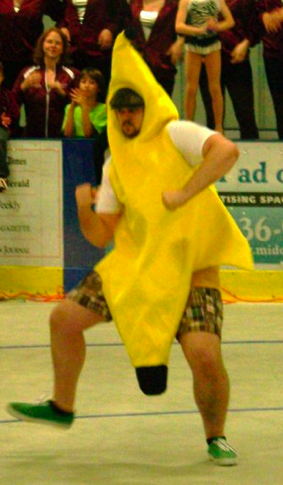
If you’re strapped and just don’t have a halftime show, there is an easy way to make one: Use your announcer. My last league had a mascot (a bananasuit borrowed from a local nonprofit — no, my league wasn’t “The Bananas” but kids liked it and it was free, so we used it.), so when one halftime show went a bit awry (sound system issues — try all CDs in your soundsystem first!) BP quickly invented “the banana race” which is when the announcer told every kid in the audience to come to the track and on 1 … 2… 3… chase the banana around the track! It’s entertaining, easy, free. You could also do “push the derby girl” race with three of your derby skaters in a squat while kids push her around the track. Etc.
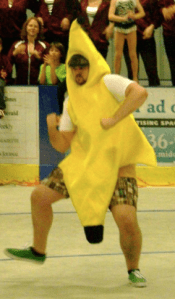
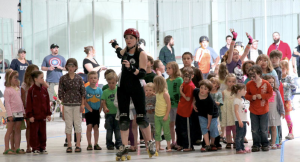
I once led the “banana race.”

Clean up: Your audience is made of cool people. We know this because they like derby. So, make sure your announcer asks the audience for help cleaning up after the bout. The basics: throw out trash and help rip up the track (if necessary). People can be super good about this. To help them be super good about this, make sure there are lots of trash cans around the venue so people feel it’s easy to clean up after themselves. Have them by the exits and near major walkways.
My old league had a “nobody goes to the afterparty until the venue is spotless” rule — and I think it’s a solid rule. Each leaguemate had to “check out” with a BP person to make sure there was no more work to be done. If you are the BP manager, you stay last and do a final walkthrough and make sure everything is sparkling. By leaving a place better than you found it, you’re more likely to be invited back. But you knew that.

Extra tips:

  • Contact your local churches and schools to see if you can borrow tables (admissions, for volunteers to eat pizza, for the vendors, etc) and chairs (for handicap seating, VIP seating, vendors, penalty box and benches, etc) free.
  • Local farms that grow garlic often have large, industrial fans to dry the bulbs. These feel nice and breezy on the bench. Send a few emails to see if your league can borrow one for bout night. Always offer tickets in exchange for favors; it’s just polite and gets more derby buzz going in the community.
  • Like the “pull in more ticket sales by having a halftime show” you can do the same with the national anthem. If you have the local high school choir (25 kids?) sing the anthem, you might reap 50 ticket sales from their parents who want to hear them sing. Try to involve as many people in the bout as possible.
  • If your bout is family friendly, make it family friendly. Maybe get a local facepainter to hang out in vendor village. Or a hula hoop maker. One $2 solution is to go to Goodwill and buy a Twister board. Put it in vendor village and leave it there. Kids will play. And parents will shop in your sponsor village. Win win!

Epitaph: This isn’t a complete list. This isn’t a “do this, don’t do that” guide. You have to do what works for you, your committee, your league, your audience, your venue and your community. So do that. Do what feels right. But above all else, remember: You do derby because it’s fun. Your fellow leaguemates bout because it’s fun. That’s why they help with bouts. Volunteers help because derby is fun and because they want to be part of this world. Be nice to everyone and thankful and make sure that people who just want the inclusion of being in this world get that. Have fun. Relax. Make it fun. Chill out. DON’T FREAK OUT. Ever. (And if you have questions, leave them in the comment section and I’ll answer them, or maybe someone more knowledgeable than I am will answer you.) Luck!

Happy bouting!

A very derby Halloween

My league recently bumped up my “level” so now I can practice with home teams. Yey! My practice schedule opened from Thurs, Sat, Sun to Mon, Tues, Weds, Thurs, Sat, Sun. Good thing I love to roller skate.

Tonight is the Halloween scrimmage. I’ll try to remember to bring my camera for you all. I think I’m going to go as a figure skater.

I’m adjusting here. I used to walk into the practice space and go “WOW!!!!!!!!” and now it’s more like, “OK. Time to gear up.” That in itself is weird to me. The other day before practice I pulled my gearbag out of my trunk and looked at my old league’s sticker on my bumper. I thought about why I don’t yet have my new league’s sticker. It feels like my heart is in Maine and my skates are here, a little bit. I know my heart will follow. Eventually. It’s scary to get a new normal. Speaking of scary:

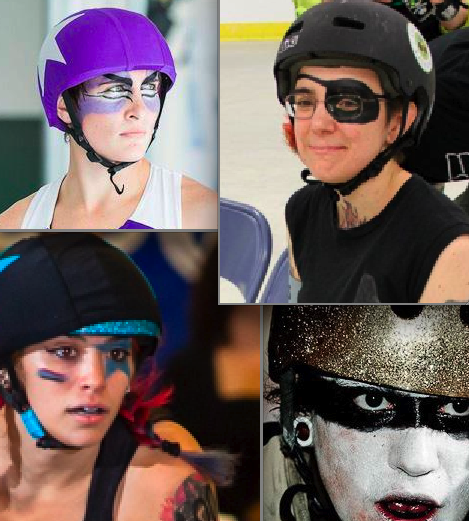
Happy Halloween. Here are some badass derby skaters who wear face paint:

I know some of ya’ll have worn face paint for derby too. Post photos below? I wanna see.

Thing I’m proud of: Making my new skater status, quickly. Three I’m grateful for: This last bit of downtime before starting my new job, my friends in Maine who listen to me when I want to blab on about derby here, my new friends here who bring me to the bar after practice and let me hit them in the face. Whoops.

Antidote

Today DerbyLife published a feature article/interview I wrote on Philly rollergirl Antidote. She has been working for 7 years to get where she is. Story below:

Champs preview: Antidote from Philly Roller Girls

By Hard Dash

You’ve got to fail to succeed, seems to be Antidote’s mantra these days. And she’s succeeding. The 26-year-old jammer for Philly Roller Girls dashed through scrum-start walls at Eastern Regionals to pick up lead jammer seven out of her nine jams against London.

Antidote, who grew up in Delaware, has been playing derby for Philly since 2007. But the athlete with the star on her eye says life lengthened her journey to her first Liberty Belles game — by about six years. Now, with some hard fought battles — on and off the track — behind her, she’s ready for more derby.

The jammer helped Philly take home second place — to Gotham Girls Roller Derby of New York — at regionals. Now the team is getting ready to skate their way up the ladder at Grits and Glory, WFTDA’s national championship Nov. 2-4 in Atlanta, Georgia.

Philly will battle the Bay Area Derby Girls first. If history is any indication, this bout will be tight enough that fans should bring cough drops, lest they lose their voices screaming. According to the Liberty Belles captain, Teflon Donna, the team is thrilled to battle BAD. Since 2007, the teams have played twice.

“At the WFTDA Championship tournament in 2008, Philly narrowly escaped a last jam comeback attempt from the BAD girls to go on and face the Texecutioners in a battle for 3rd place and [we played them] again in June 2011 in Philadelphia in a hangover bout where BAD came back in the last jam to beat the Liberty Belles,” Teflon Donna said. “Coincidence or not, the Philly Liberty Belles find themselves once again in a championship bracket facing off against BAD where the victor goes on to play the Texecutioners.”

We talked with Antidote about her derby journey and what she’s thinking about before nationals:

HARD DASH: How long have you been skating?
ANTIDOTE: I rollerbladed growing up, playing roller hockey around the neighborhood and going to the weekend open skates. I stopped skating while in middle school and didn’t again until I tried out for my first league [in 2006]. I strapped quads on for the first time ever at the tryout.

A year later in 2007 I moved to Philadelphia and joined the Philly Roller Girls, first as a Hostile City Honey and shortly later as a Liberty Belle. So life happened and I maintained skating as an Independence Doll (our B team) until this year when I returned to the Belles.

HARD DASH: Life stuff?
ANTIDOTE: Derby was my reason to sober up from both drugs and drinking in 2007. During this journey, my life became intertwined with my youngest sister’s battle with depression and an attempted suicide. That next year my father passed of lung cancer — that had been the week of the 2008 regionals, which was going to be my first regionals, but I bailed since his health got progressively worse. That was the last time I was rostered as a Liberty Belle before returning this year. Derby and life had been made very difficult by an emotionally abusive marriage, which led to a divorce almost a year after my father’s passing.

Then it was the “what now” feeling. I had at this point been battling with depression myself, which caused me to gain a lot of weight. I had shut down. I lost my drive for derby and life. The Team USA tryout was my turning point. I hadn’t worked toward anything in a while. Being cut sucked, but it opened my eyes to the fact that I needed to figure out what I wanted in life.

The first practice after that cut I had that feeling of the first time I strapped on skates and everything felt new again. I knew I wanted to be the best skater I possibly could be. I wanted to feel like I was the best me. It sounds so cliche to say derby saved my soul, but I guess it sounds that way because for many of us it has. It gets to a point where there is no separation between derby and life, we do one to do the other — the other means nothing without the first. … Or something deep like that.

HARD DASH: I’m sorry to hear that, lady. You sure you want the derby world to know all this?
ANTIDOTE: I think it is important and perhaps it will help someone in the end. So yeah, I think I am ready to share it.

HARD DASH: So how did you get so awesome at roller derby?
ANTIDOTE: Failure. No joke. I tried out for Team USA and made it to the final tryout, but got cut before the final scrimmage. I spent the next week mapping a plan on how to re-do my whole thought process on training and what I wanted from derby.

HARD DASH: What do you want from derby?
ANTIDOTE: I want to be skating and coaching it until I can’t anymore.

HARD DASH: Oh OK.
ANTIDOTE: By that point I had been skating for 5 years and it hit me that it was beyond time to go big or go home. Since the tryout I have been training five times harder than I ever have, eating better than I ever thought possible, and making sure every day I remind myself why I play this game. I play it because I feel most alive when I am on that track.

HARD DASH: Do you have short- and long-term goals?
ANTIDOTE: I try to make daily goals. Not just for derby, it’s a mind, body, soul kind of thing. I believe it is just as important to make your mental game just as strong if not stronger than your physical — otherwise this sport can take a toll. So, one of my goals this past year has been to tell myself every day that today I will be stronger than yesterday. I hope by achieving my small goals that in the long run I will get another shot at Team USA and see Philadelphia take home the Hydra.

HARD DASH: What’s your daily goal today?
ANTIDOTE: Today we had practice and my goal was to only take the middle of a wall when I was jamming. Yesterday it was to tell every one of my teammates on my home team something they were doing really well.

HARD DASH: Got a signature move?
ANTIDOTE: I guess if I had to name a signature move it would be what I call “drop shoulder.” It’s breaking walls moving or scrum with a low dropped shoulder into a can opener to force yourself in and out of a wall.

HARD DASH: What’s it like to skate in a dress?
ANTIDOTE: I LOVE IT. I prefer it. There is always material in arm’s reach to grab when I need an assist. And it’s airy.

HARD DASH: Weird. You ever block?
ANTIDOTE: I like blocking, but I love jamming. I love the adrenaline. I love knowing that there are five people on that track who want to see me fail and four who will do whatever is in their will to make sure that does not happen. I love the speed. I love the feeling when I take someone’s point. I love the pressure knowing my team is relying on me and I refuse to let them down.

HARD DASH: Do you have a skating buddy?
ANTIDOTE: Shenita Stretcher and I have been skating together for 6 years. Not just as a Belle, but also for our home team, the Broad Street Butchers. We know each other well. You won’t ever see it, but V-Diva and I play really really well together as blockers — we just both jam more than block.

HARD DASH: On that note, it seems like Philly is D D D and their jammers never get help. Sometimes it seems brutal. As a jammer, do you like that strategy?
ANTIDOTE: Personally I really like it. It is harder, but it has forced me to become a stronger jammer.

HARD DASH: Any tips for jammers?
ANTIDOTE: Never stop moving your feet forward and eventually to the left.

HARD DASH: What about for people just starting derby?
ANTIDOTE: Patience. And a lot of it. Life doesn’t always give us the time to put as much as we would like into this “hobby.” Don’t get frustrated if you aren’t moving up as fast as you want. After 6 years of work to be rostered in a sanctioned WFTDA game I can still say it was all worth the wait.

HARD DASH: Wait wait wait. This year’s regionals was your first ever WFTDA-sanctioned bout?
ANTIDOTE: No. But it was my first regionals, and the first time I ever started a Belles game. Earlier this year was the first time I had seen action in a WFTDA-sanctioned bout.
HARD DASH: Gotchya. That’s still pretty badass.

HARD DASH: What’s your proudest accomplishment?
ANTIDOTE: Truthfully, this whole past year. I have gone through a lot of bad things the last couple years and it feels amazing to know that I didn’t let myself use it as an excuse for why I can’t, but instead the reason why I had to keep moving forward.

HARD DASH: You seem really happy when you play. All the time.
ANTIDOTE: Derby has gotten me through a lot in my life. I am thankful every time I hit that track and know that at least I get to play one more time.

HARD DASH: What’s with the face paint?
ANTIDOTE: Years ago I painted the star on [my eye] to add some pizzazz. At the end of that game a little girl walked up to me and told me that I was her favorite superhero. It made me feel like a superhero. I still do it because it reminds me of that feeling.

HARD DASH: Is there any significance to your name and number?
ANTIDOTE: Most people don’t know I had a different name when I first started skating derby — one I will never tell. When I decided to change it I knew I wanted a name that was one word and easy to say. Antidote sounded tough. As for my number [100cc], its the medium speed setting for Mario Cart 64 — 150 the high setting was too much of a mouth full.
HARD DASH: HA!

HARD DASH: So are you pumped for Championships?
ANTIDOTE: I have been waiting almost 6 1/2 years to see a championship game, so I am gonna say yes.

HARD DASH: What are you most pumped about?
ANTIDOTE: Seeing all my team’s efforts from this year come together.

HARD DASH: What are you doing to prepare?
ANTIDOTE: Taking my vitamins A to Z, drinking lots of juice boxes and taking naps.

HARD DASH: What do you and your teammates talk about on the bench?
ANTIDOTE: We consistently motivate each other and remind ourselves that each jam is a new jam.

HARD DASH: Is there something people should look out for in the Philly Roller Girls? Got any surprises?
ANTIDOTE: We always have a trick up our sleeves.

HARD DASH: Your first game is against the Bay Area Derby Girls. Are you worried about BAD at all?
ANTIDOTE: You always have to worry about your opponents. When you stop worrying you set yourself up for failure.

HARD DASH: Thanks for talking with us. I think people are curious about you because you’re talented and seemed to have come out of nowhere.
ANTIDOTE: The funny part about this is I have been playing derby for almost 7 years. I have been here, I was just waiting for life to tell me it was my turn.

Hard Dash is a journalist living in Portland, Oregon. She skates for Rose City Rollers.