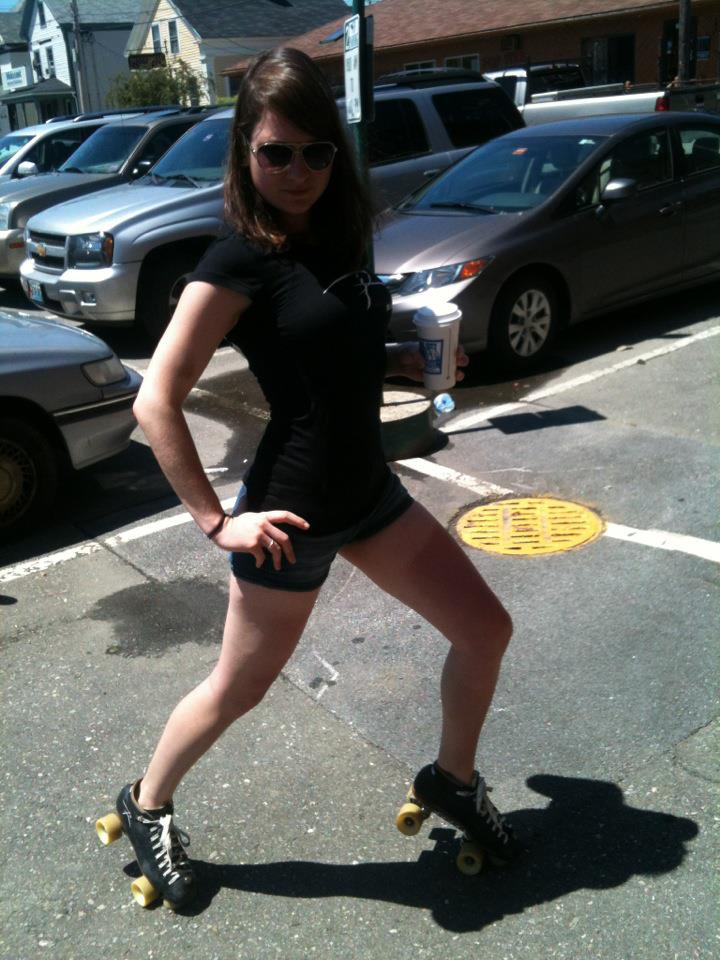
The prospect of outdoor skating can be scary, but you should do it anyway. Here’s why:
1. It will make you better at roller derby.
Skating outside is the only reason I have a solid “c cut” (quick cut to the in and out. Often used in drag-out hits or to gain position in a one-on-one scenario). A year ago I couldn’t plow stop with confidence, and when you’re headed down a hill toward a road with busy traffic you have a few options (if you’re not good at stopping):
A. “Cut” down the hill like a skier.
B. Fall
C. Die
I also learned lessons in stability (Hello rocks, sticks, cracks in traffic, sand …) and awareness (And hello to my friends: “dog who hates roller skates,” child, traffic …) and jumping (fuck you, broken pavement, those bumpy sewer tops, dead squirrels …).
2. It will even you out.
When you outdoor skate — unless you’re that girl who is trying to do derby drills on a fake track she made in the high school’s bumpy parking lot* — you can even out your muscles. Long, straight paths, hilly trails, they challenge your muscles more equally than skating counterclockwise for hours.
3. It can be good for your league.
Wear your league shirt. Bring fliers. Go to a bar or cafe in your skates when you’re done. Be nice. It’s amazing how many people want to chat about the sport when they see you in skates.
4. You’re too pale.
I said it.
5. It’s fun.
Duh. Grab a friend. Go for a skate. Get some sun. Crash, exhausted on someone’s lawn (STAY OFF OF MY LAWN) and remember why you love roller skating.
It’s nice to be in a larger league. It’s so nice. The league here is a 501c3 and already has its life together and leadership and some paid employees. But I’ve been talking with some skaters from my previous league and I’m missing it this summer.
Here’s what small leagues have going for them:
–Tight teams. By the numbers alone, smaller leagues’ teams are well meshed. When you’re in a league of 30 people total, you know how every one of them jams, blocks, evades. When you’re in a league of 150+ people, it’s impossible to get the same level of familiarity.
Sinner of Gravity is my last (tiny) league’s star jammer. I felt I always knew what she wanted from me. Sometimes, a backward-ish whip.
–Close communities. By nature, smaller leagues are usually in less populous areas. The league has to be an active community member to stay skating. And while going to every parade in town (Lobster Parade*, Fourth of July, other Fourth of July, skating for kids’ programming at the high school …) can be draining, it’s also so cool to get a small community buzzing with excitement before a bout. It’s hard to get a whole city pumped, but a small town? Everyone knows a derby girl in a small town.
–F-ing dedication. We’re all dedicated to our sport, but if you’re in a league of 20-40 people, it takes a lot more volunteer time and dedication to the not-fun jobs than if you’re in a larger league. Someone still has to be president, organize WFTDA paperwork, do insurance, make bouts, make posters, run practices … but with fewer bodies to do the work.
–More relaxed fun (?). Everyone cares about getting plays down, talking strategy and perfecting hits, but when you’re not worrying about a national ranking, there is time for roller disco lessons and games as drills.
–Creativity. I’ll say it. I’m going there. It’s the same philosophy as above: When you don’t have to care about a ranking, or your stats, or making travel team or being on wftda.tv or whatever, you can loosen up and think about lining your whole defensive wall up backward in a “rugby start” or other weirdo ideas. Less pressure, more risk.
–More track time. At a large league, you might split the track with a junior league, home teams, travel teams, etc etc.
–More game time. If you’re on a small league, it’s easier to make travel team. It’s easier to get rostered. It’s still hard. It’s hard everywhere, but there’s less competition.
Last week after a practice I spoke with a fresh meat skater. Then I spoke with a travel team skater.
The fresh meat skater said she is nervous that people don’t notice her. A home team draft is coming up and what if no one wants her?
The travel team skater said she’s nervous that her coaches don’t notice her. A bout is coming up and what if she doesn’t get game time?
What does this say about us? Derby doesn’t get easier. Your insecurities don’t go away. You just get better. — Is that the takeaway? I’m not sure, but this has been rumbling around in my brain all week.
Tomorrow I’m giving an interview on media’s effect on roller derby.
It seems the interviewer wants to know about the media’s portrayal of derby and how it affects the sport, etc etc. Ughhhhhhh.
It’s a hard situation, because basically my answer is, “it’s complicated.” And no journalist or researcher likes that answer. It’s not clean and tied up with a bow. To organize my thoughts pre-interview, I wrote it out:
The way the media portrays the sport is a direct reflection of how society views ambitious women: scary(?), laughable and highly sexualized.
Skaters work their assess off to create nonprofit organizations — not as a job, but on the side — and also to become athletes. Yet countless news articles and TV shows condescendingly report on the sport like a quirky little side show.
You probably saw my long list of “by day, by night” leads on news articles. (“By day Heather is a serious reporter, by night she puts on eight wheels and hits bitches!”) Those — from different papers of different sizes from different places by journalists of both genders — show how society thinks it’s ridiculous for a woman to both have a good job and play roller derby. Connotation: playing roller derby is not serious. It’s silly. (And hot?) Don’t you have babies to take care of?
Then there are the reality shows that put women who’ve never skated before (and probably never wanted to) on skates and say, “this is roller derby,” as Em Dash recently wrote about.
Blah blah blah.
It’s equally our fault.
Many leagues market themselves (bouts, fundraisers) as a hard-hitting, fast-skating, sexualized spectacle. Otherwise, they might not sell tickets. It’s how we lure people into the sport. THEN they see athleticism, teamwork and everything it takes to run a bout.
It’s frustrating that a women’s sport has to market itself that way to get an audience and then to hope the audience learns who the sport actually is.
I got a lot of response to that post about the $50 million derby story. The comments that weren’t from skaters/refs included a dissenting minority with the totally valid point of — “but you guys wear fishnets and have your bums hanging out of your metallic panties!”
People don’t walk into their workplaces dressed like that. Or soccer games for that matter. Because they want to be taken seriously. They instead dress like workers. Or soccer players. We are in a sport where people don’t dress like athletes. There is the struggle of how a lot of us see ourselves (serious athletes who eat for their workouts, think for their workouts, plan their practices and goals, committee members building 501c3s …) and how we present ourselves. And until we resolve that, it can’t totally be the media or fans or anyone else’s fault for thinking of derby as side-show-like or super sexualized. It’s hard to see the thousands of hours of nonprofit work, the training, the athleticism behind fishnets and gold glitter shorts*.
So, like I said (“Ughhhhhhh”) — it’s complicated.
*I feel obligated to buffer and say, “your feelings are valid. Wear glitter shorts and be an athlete. Get it girl. Just don’t expect fans and the media to take you seriously at first. And journalists only ever get an ‘at first.'”
I saw my first in-person Wheels of Justice bout this weekend. After watching them online for years. Things I have to say about it are: IT WAS AWESOME and this:
It’s been a while since we last talked. In that time, I was drafted to my hometeam, the Heartless Heathers. Yey!
I’m a viking ice queen now. Photo by Masonite Burn. (Who is awesome.)
It’s been a big change from trying to show my stuff (usually meant going offense, etc) to trying to mesh with my teammates and work well together. A fun, new adventure.
Speaking of a fun new adventure. Guess who went to Maui? Moi.
Oregon put together a team of skaters from all around the state (and some from Washington state) to fly out for Maui Roller Girls’ 5th birthday. Happy birthday, Maui! The league had a few days of bootcamps with Mel Mangles (Rose) and Killer Kelly (Rat — and founder of Maui Roller Girls) before taking on the Oregon team.
It’s been seven months since I skated for my small league in Maine. Seven months is enough time to get nostalgic, but also to forget a little about how hard it is to be in a small, new league.
Maui isn’t all that new, but it is a touristy island. As I understand it, people come and people go. Skaters come and go. So, although MRG is five, a lot of their skaters aren’t. Lots of turnover.
It was sort of a plane flight back into time (Maui, Maine, totally similar, right?) watching these ladies hold their walls together, learn the intricacies of bridging, etc. And it was a lot of fun. MRG found a bout space in a hangar (more on that in a sec), so we were out of the rain. The game was close and ultimately Oregon won. But with an after-party in a thatched-roof Hawaiian canoe club open to the sandy beach along the bay, let’s be real, we all won.
After the bout was over, I stayed for another Maui practice. Maybe you’ve read elsewhere about Maui’s space. High rents mean no real home, so these ladies skate outside. This is nice when it’s sunny, but Maui is a bipolar island with a chunk of (beautiful) mountains — on one side of the island it’s usually sunny and gorgeous. On the other side, torrential rains fall sporadically. Guess which side the league is on.
Thankfully, the weather held on the night I skated outside with them. (And thankfully, they found a place to bout inside) All it took was them setting up a bunch of lights (in a very creative way — attached outdoor lights to poles, put poles through wood horses. See pic above. Easy. Cheap. One extension chord did the trick, I think) And man was it fun. It was fun to play with varying skill levels and intensities. I remembered my roots a little clearer and how fun and frustrating learning to play this sport is at that stage. And how much enthusiasm and love it takes.
So, thanks Maui! Thanks for playing with me, putting me up and letting me practice with you.
My league-mate Frisky Sour keeps a blog about derby and manatees. This week she featured one of my other league-mates, Scarlene, who talked about mental toughness. Listen to the lady. She’s hilarious, pretty and smart. Woah.
Here is an excerpt of their interview:
Frisky: What is mental toughness, and why is it important?
Scarlene: In my humble opinion, roller derby is 80% mental. You have to convince yourself that you aren’t tired, you can get back up again, you aren’t afraid of anyone you’re blocking/jamming against, you know what to do when your teammates get penalties and leave the track. The list goes on and on. When everything else fails, or seems like its going to fail, you can really only rely on your brain.You practice strategies and skills over and over again – do you do the same thing for your brain? Do you visualize greatness or agonize over mistakes? We are most critical of ourselves and need to look inward for strength when, for lack of a better term, shit is gettin’ cray.
You led a session at Derby Daze last summer about mental training, which I hear was super popular. What do people want to know?
I have a lot of catch phrases I use in my life. Almost every time I step on the track I have to have a mantra to stay focused. I shared a lot of those, and stressed the importance of staying positive. Instead of saying “I’m not going to the box,” say “I’m going to skate clean.” If you’re plagued with arms penalties, think about putting emphasis on your hips instead of thinking about NOT using your arms. Many moons ago a coach told me to stop looking at the wall I want to bust through and look THROUGH the wall at my destination. It was such a simple thing but has always stuck with me. I use that for my mental game as well. I don’t think about the thing I don’t want to do, I think about what I need to do to succeed instead …
The post “Journalists miss the real ($50M) roller derby story. Every Time” got more than 17,000 hits in one day. … and that’s before it got posted to Derby Life. This probably confirms two things: that the roller derby roster that says there are 39,000 of us is probably right (or an underestimation, as some of you pointed out) and that we do have reach.
I feel like the post deserves a follow. I tried to think — past the mucus, the nausea and the hours upon hours of sleep — about *why* this caught fire. Here are some hypotheses:
1. We feel misrepresented by the media
2. We feel our sport is epic, valuable and growing and deserves recognition as such
3. We know the monetary value of this is meaningful
Those are my top three guesses. As a journalist for the past seven years or so, I know I can’t actually ever pinpoint why people click and share the way they do. But the fact that this article blew up means something and I want to delve into that a little.
In case you don’t want to click through 11 versions of the same story, those are all the by day/by night story. YOURTOWN — By day you are a professional who thinks and talks and is productive, by night you are a roller skating super hero in fishnets with a whacky name!
2. We feel our sport is epic, valuable and growing and deserves recognition as such
– As the people with boots (Riedell, Antik and Bonts, mostly) on the ground, we know this is epic. We witness around us a rise of thousands upon thousands of women coming into this community in a viral way that might be harder to see as an outsider. So, maybe it tiffs us off to not see this represented. It feels epic, it is epic, and no one seems to notice. I think the postings of the article saying “THIS IS WHAT I’VE BEEN SAYING” point to this.
3. We know the monetary value of this is meaningful
– Some commenters were saying that they will hand out “Journalists miss the real ($50M) roller derby story. Every Time” in their sponsorship packets — or should. And I think that’s a big part of it. We, as committee members and league members, have to sell this sport, literally. And we have not all been given great resources to do so. It’s hard to cite good data and it’s hard to find someone to explain that data in real terms. Sure, WFTDA says skaters spend such and such on each item, but they don’t add it up in a way that is very marketable. Maybe that’s what we were waiting for and excited about. WE know this sport is epic and massive and that translates into dollars … but how??? And my last blog post did not even do a very good job at going into that. It’s a huge underestimation that doesn’t account for most of the derby industry
How many bouts are there each year in America? 3,000? And if each makes a measly $2,000 that’s another $6 million. If there were only 250 leagues — there are way more — and they each spend $600 a month in rent, that’s $1.8 million. What about merch? If each of the 250 or so WFTDA leagues — not other leagues — sold $1,000 in merch each year that’s another quarter million …. raffles, fundraisers, parties, other related economies …. ).
If 250 leagues each go to six away bouts a year and rent four hotel rooms at $100 a night, that’s more than half a million dollars. Shall I go on? How about just championships? Sending 11 teams to championships is probably more than $50,000 in hotel rooms alone and another $50,000 in flights (if only eight teams have to fly). Not including the food they couldn’t bring on the flight, the fees, the necessities they buy at local stores when they’re there. And there are conventions …Even the tiny NE Derby Con I wrote about is about $150 a person for 500 people, which is $75,000 in tickets, probably more than $20,000 in hotels ….
It adds up. We need someone to add this up.
So that’s why I think this took off. It’s also why I think more research has to be done. More importantly, better marketing MUST be done to show companies, sponsors, communities, Chambers of Commerces, etc the value — the real value of roller derby. Every other industry has a round figure of what they are worth, which gives them more clout to sell themselves. We need that. Desperately, apparently. And it’s sad to say, but the media isn’t going to chase this without derby making the first move. Without numbers laid out for reporters, the job is way way harder — perhaps insurmountable. But we have the power to gather this information. I’d encourage derby governing bodies to consider asking their constituents for some data — not to share on a league-by-league level, that’s private, but to share in a big-scale way so we can have the numbers to put behind us. These numbers would empower us to market the shit out of our industry and show it’s legitimacy as an investment for our sponsors all over the US and the world.
News reporters miss the roller derby story every time. Every. Time. Distracted by the glitter, wheels, hitting and names that are bleach-penned onto our shirts, journalists slip and don’t cover roller derby like they would any other trend news story.
Regional and local papers always write the same story: YOURTOWN — By day Lacy Clems, 33, of Yourtown, is a nurse at Yourlocal Hospital. But by night the nurse pulls on her fishnets, laces up a pair of black roller skates and takes her place with the Local Rollergirls. (And then 600 more words about how people roller skate in an oval and somehow there are points scored, it’s maybe about community service and women and athletics, and also some quote about how one of the ladies uses this as stress relief from her babies and job.)
Where were they at the first-ever world cup? Where were they at championships in 2011 and 2012 when Gotham slaughtered everyone? For the Times, it’s not just a local hokey story, it’s a national story, it’s an international trend. It’s sports, entertainment, news, economics, business. It’s a video opportunity. It’s gorgeous photography waiting to hit A1 or the cover of sports.
No matter.
They — and all newspapers — are missing the story. So, let me give it to them. This is for you, fellow newspaper reporters of the world: Derby is the viral sport of this past decade. It has infected your town. It has infected every town in this country and many cities everywhere else in the world. In Rockland, Maine there is roller derby. In Austin, TX there is derby. Athletes skate in Berlin, London, Sydney, Brasília, Moscow, Toronto. They skate in Lansing, MI and in Moab, UT. And to those towns — those towns that can be dull, cloudy, economically depressed — these leagues are raking in two things: Women, money. To the former point: We are EVERYWHERE.
To the latter: As reporters, we love to “follow the money.” But when it comes to these hundreds of local businesses and nonprofits … nothing. Nothing on the multi-million dollar industry that is derby.
This bout brought in about 2,000 people (capacity) … in a town of 3,000 people. That brought in ticket sales, got sponsors advertising time, brought in money to the local hockey rink … and to the police force which surely collected parking ticket money. Photo by Eric Baseler.
The nonprofit Women’s Flat Track Roller Derby Association looks over about 250 leagues. The roller derby roster — a derby name registry — has 39,239* skaters (mostly women) listed.
I’m sorry, I’ll say that again because maybe you didn’t quite read that right: 39,239 skaters. That’s as many women there are in Portland, Maine (the state’s biggest city).
OK. Now, let’s do math. Blog followers know how I love math. According to a study by WFTDA last year, skaters spent an average of $622 on skating equipment and gear in 2011, along with $656 in travel for roller derby and $223 in other support costs (dues, tickets for events). That’s $1,500 a skater. If there are in fact 39,239 skaters that is $58,858,500 — yeah, about $59 million a year from just the skaters — not the fans, the referees, the support staff, bout venues, rinks. That $59 million goes to local skate shops, local rinks, American skate companies, local hotels.
It’s a big fucking deal. (Do you hear me, New York Times?)
According to that WFTDA study last year, a third of derby fans make more than $75,000 a year. They have disposable income. Income to spend on $5-$30 bout tickets, merchandise and all the companies surrounding and sponsoring the sport.
They also have reach. About 36 percent of fans heard about derby through a friend. We have a crazy-huge network of people buzzing about derby in the world. I don’t have figures for how many derby fans there are in this world or how much they spend to travel to see games, how much they pay to stay in your towns, to eat in your towns, to support the local roller derby sponsors. Etcetera.
That’s where the story is. Somehow journalists have missed the (way more than) $59 million story of derby. A very basic story about the immensity of this sport that has lodged its claws into our nation. Sure it’s also about how thousands upon thousands of women have become better human beings: become athletes, learned to run a nonprofit, found a safe space to grow, and yes, a place to get away from stressful jobs and babies where they can wear fishnets and no one will call them a slut (…. OK, we might call them sluts, but it’s loving, not shaming.)
This sport is changing our world and impacting our local economies in a real, quantifiable way. GET ON IT, PRESS.
PORTLAND, Ore. — A journalist by day, Heather Steeves, 25, of Portland, types angrily at her keyboard. But by night, Steeves — aka Hard Dash — straps on her old-style black roller skates and elbows you in the face.
*That 39,239 number might be inflated number because of skater drop outs — but there is also a huge back up of names waiting to be registered, so it’s unclear. (To make it harder to estimate: WFTDA does not keep a headcount of skaters, and even if it did, that number wouldn’t account for the non-WFTDA flat track leagues, the banked track leagues, the USARS leagues, the renegades …)
As you know, I moved from my tiny league in Maine to a nationally-ranked league. As a home team draft approaches, where people will be picked from “the pool” to join teams that choose to have them, I’ve been reflecting on my experience so far. Mostly because when I chat with other transfers here, we all share a lot in common about our thoughts on the process. That said, the thoughts below are my own.
1. Your experience in “the pool” will be different from the fresh meat’s experience.
This is the one most on my mind these days. The fresh meat who are waiting to be picked up by home teams are so nervous, they might burst, it seems. Stressin me out. It’s probably a lot like what prom would be like if you went to a school with only 5 girls, 4 boys and all the girls cared if they got asked. They’re looking around, seeing who is pretty, who is most pretty, which boys are hot, which boys can dance, and a lot of them seem to think so long as they’re asked by ANY boy, they’ll be happy forever.
As a transfer, it’s not prom, it’s marriage. It’s a negotiation of who is hot enough, who is nice, who will get your jokes and who, in the end, will be your family. That’s how it feels to me. These people are about to be my family and I want to make sure there is a place I can play and grow in that family.
But I get the freshie stance, this is like a graduation day and it’s a big deal and something totally worth being excited about. It’s just a little different for transfers.
2. You don’t skate like they skate
That’s just the way it is with a new league. The things your last league yelled at you for might not be the things your new league will yell at you for. (Well, not “yell at” …) In a way, you have to relearn things. It’s a difficult balance of keeping your style and spark while matching the new game.
On the other hand, it’s a lot of fun to learn new skills and styles, but also keep your old tools in your tool belt to pull out. Sometimes you’ll hear a “woah, what was that?”
3. You might not be who you were
Wow. Sounds philosophical. No. I just mean if you were the president of your last league and ran three committees and were always a pivot in your last league, this new league might need you to instead me on the sponsorship committee in a smaller role and jam. Transferring can be about re-invention and learning a whole new way to play derby and it’s a new start to be the derby girl you always wanted to be.





 The Dashboard