The 3 reasons you read “Journalists miss the real ($50M) roller derby story” — and what needs to be done now

I would have posted sooner, but I caught the flu.

Wow.

I mean: WOW.

The post “Journalists miss the real ($50M) roller derby story. Every Time” got more than 17,000 hits in one day. … and that’s before it got posted to Derby Life. This probably confirms two things: that the roller derby roster that says there are 39,000 of us is probably right (or an underestimation, as some of you pointed out) and that we do have reach.

I feel like the post deserves a follow. I tried to think — past the mucus, the nausea and the hours upon hours of sleep — about *why* this caught fire. Here are some hypotheses:

1. We feel misrepresented by the media
2. We feel our sport is epic, valuable and growing and deserves recognition as such
3. We know the monetary value of this is meaningful

Those are my top three guesses. As a journalist for the past seven years or so, I know I can’t actually ever pinpoint why people click and share the way they do. But the fact that this article blew up means something and I want to delve into that a little.

1. We feel misrepresented by the media
Cliche
Cliche
Cliche
Cliche
Cliche
Cliche
Cliche
Cliche
Cliche
Cliche
Cliche (I’m only stopping because I’m bored now.)

In case you don’t want to click through 11 versions of the same story, those are all the by day/by night story. YOURTOWN — By day you are a professional who thinks and talks and is productive, by night you are a roller skating super hero in fishnets with a whacky name!

2. We feel our sport is epic, valuable and growing and deserves recognition as such
– As the people with boots (Riedell, Antik and Bonts, mostly) on the ground, we know this is epic. We witness around us a rise of thousands upon thousands of women coming into this community in a viral way that might be harder to see as an outsider. So, maybe it tiffs us off to not see this represented. It feels epic, it is epic, and no one seems to notice. I think the postings of the article saying “THIS IS WHAT I’VE BEEN SAYING” point to this.

3. We know the monetary value of this is meaningful
– Some commenters were saying that they will hand out “Journalists miss the real ($50M) roller derby story. Every Time” in their sponsorship packets — or should. And I think that’s a big part of it. We, as committee members and league members, have to sell this sport, literally. And we have not all been given great resources to do so. It’s hard to cite good data and it’s hard to find someone to explain that data in real terms. Sure, WFTDA says skaters spend such and such on each item, but they don’t add it up in a way that is very marketable. Maybe that’s what we were waiting for and excited about. WE know this sport is epic and massive and that translates into dollars … but how??? And my last blog post did not even do a very good job at going into that. It’s a huge underestimation that doesn’t account for most of the derby industry

How many bouts are there each year in America? 3,000? And if each makes a measly $2,000 that’s another $6 million. If there were only 250 leagues — there are way more — and they each spend $600 a month in rent, that’s $1.8 million. What about merch? If each of the 250 or so  WFTDA leagues — not other leagues — sold $1,000 in merch each year that’s another quarter million …. raffles, fundraisers, parties, other related economies …. ).

If 250 leagues each go to six away bouts a year and rent four hotel rooms at $100 a night, that’s more than half a million dollars. Shall I go on? How about just championships? Sending 11 teams to championships is probably more than $50,000 in hotel rooms alone and another $50,000 in flights (if only eight teams have to fly). Not including the food they couldn’t bring on the flight, the fees, the necessities they buy at local stores when they’re there. And there are conventions …Even the tiny NE Derby Con I wrote about is about $150 a person for 500 people, which is $75,000 in tickets, probably more than $20,000 in hotels ….

It adds up. We need someone to add this up.

So that’s why I think this took off. It’s also why I think more research has to be done. More importantly, better marketing MUST be done to show companies, sponsors, communities, Chambers of Commerces, etc the value — the real value of roller derby. Every other industry has a round figure of what they are worth, which gives them more clout to sell themselves. We need that. Desperately, apparently. And it’s sad to say, but the media isn’t going to chase this without derby making the first move. Without numbers laid out for reporters, the job is way way harder — perhaps insurmountable. But we have the power to gather this information. I’d encourage derby governing bodies to consider asking their constituents for some data — not to share on a league-by-league level, that’s private, but to share in a big-scale way so we can have the numbers to put behind us. These numbers would empower us to market the shit out of our industry and show it’s legitimacy as an investment for our sponsors all over the US and the world.

Journalists miss the real ($50M) roller derby story. Every time.

News reporters miss the roller derby story every time. Every. Time. Distracted by the glitter, wheels, hitting and names that are bleach-penned onto our shirts, journalists slip and don’t cover roller derby like they would any other trend news story.

Regional and local papers always write the same story: YOURTOWN — By day Lacy Clems, 33, of Yourtown, is a nurse at Yourlocal Hospital. But by night the nurse pulls on her fishnets, laces up a pair of black roller skates and takes her place with the Local Rollergirls. (And then 600 more words about how people roller skate in an oval and somehow there are points scored, it’s maybe about community service and women and athletics, and also some quote about how one of the ladies uses this as stress relief from her babies and job.)

And that’s the local story.

The New York Times wrote about derby today. They wrote about Gotham’s intro to derby classes.

(Takes big breath)

And before I say what I need to say, I need to be fair: the Times let a derby girl write about derby back in 2010. They did a great job in 2009 covering nationals. And, with derby fitness classes gaining popularity, they covered this story at the exact right moment. But those are all the derby articles I can find without searching too hard.

Where were they at the first-ever world cup? Where were they at championships in 2011 and 2012 when Gotham slaughtered everyone? For the Times, it’s not just a local hokey story, it’s a national story, it’s an international trend. It’s sports, entertainment, news, economics, business. It’s a video opportunity. It’s gorgeous photography waiting to hit A1 or the cover of sports.

No matter.

They — and all newspapers — are missing the story. So, let me give it to them. This is for you, fellow newspaper reporters of the world:  Derby is the viral sport of this past decade. It has infected your town. It has infected every town in this country and many cities everywhere else in the world. In Rockland, Maine there is roller derby. In Austin, TX there is derby. Athletes skate in Berlin, London, Sydney, Brasília, Moscow, Toronto. They skate in Lansing, MI and in Moab, UT. And to those towns — those towns that can be dull, cloudy, economically depressed — these leagues are raking in two things: Women, money. To the former point: We are EVERYWHERE.

To the latter: As reporters, we love to “follow the money.” But when it comes to these hundreds of local businesses and nonprofits … nothing. Nothing on the multi-million dollar industry that is derby.

This bout brought in about 2,000 people (capacity) ... in a town of 3,000 people. That brought in ticket sales, got sponsors advertising time, brought in money to the local hockey rink ... and to the police force which surely collected parking ticket money.
This bout brought in about 2,000 people (capacity) … in a town of 3,000 people. That brought in ticket sales, got sponsors advertising time, brought in money to the local hockey rink … and to the police force which surely collected parking ticket money. Photo by Eric Baseler.

The nonprofit Women’s Flat Track Roller Derby Association looks over about 250 leagues. The roller derby roster — a derby name registry — has 39,239* skaters (mostly women) listed.

I’m sorry, I’ll say that again because maybe you didn’t quite read that right: 39,239 skaters. That’s as many women there are in Portland, Maine (the state’s biggest city).

OK. Now, let’s do math. Blog followers know how I love math. According to a study by WFTDA last year, skaters spent an average of $622 on skating equipment and gear in 2011, along with $656 in travel for roller derby and $223 in other support costs (dues, tickets for events). That’s $1,500 a skater. If there are in fact 39,239 skaters that is $58,858,500  — yeah, about $59 million a year from just the skaters — not the fans, the referees, the support staff, bout venues, rinks. That $59 million goes to local skate shops, local rinks, American skate companies, local hotels.

It’s a big fucking deal. (Do you hear me, New York Times?)

According to that WFTDA study last year, a third of derby fans make more than $75,000 a year. They have disposable income. Income to spend on $5-$30  bout tickets, merchandise and all the companies surrounding and sponsoring the sport.

They also have reach. About 36 percent of fans heard about derby through a friend. We have a crazy-huge network of people buzzing about derby in the world. I don’t have figures for how many derby fans there are in this world or how much they spend to travel to see games, how much they pay to stay in your towns, to eat in your towns, to support the local roller derby sponsors. Etcetera.

That’s where the story is. Somehow journalists have missed the (way more than) $59 million story of derby. A very basic story about the immensity of this sport that has lodged its claws into our nation. Sure it’s also about how thousands upon thousands of women have become better human beings: become athletes, learned to run a nonprofit, found a safe space to grow, and yes, a place to get away from stressful jobs and babies where they can wear fishnets and no one will call them a slut (…. OK, we might call them sluts, but it’s loving, not shaming.)

This sport is changing our world and impacting our local economies in a real, quantifiable way. GET ON IT, PRESS.

PORTLAND, Ore. -- A journalist by day, Heather Steeves, 25, of Portland, types angrily at her keyboard. But by night, Steeves -- aka Hard Dash -- straps on her old-style black roller skates and elbows you in the face.
PORTLAND, Ore. — A journalist by day, Heather Steeves, 25, of Portland, types angrily at her keyboard. But by night, Steeves — aka Hard Dash — straps on her old-style black roller skates and elbows you in the face.

*That 39,239 number might be inflated number because of skater drop outs — but there is also a huge back up of names waiting to be registered, so it’s unclear. (To make it harder to estimate: WFTDA does not keep a headcount of skaters, and even if it did, that number wouldn’t account for the non-WFTDA flat track leagues, the banked track leagues, the USARS leagues, the renegades …)

3 lessons a transfer skater learns

As you know, I moved from my tiny league in Maine to a nationally-ranked league. As a  home team draft approaches, where people will be picked from “the pool” to join teams that choose to have them, I’ve been reflecting on my experience so far. Mostly because when I chat with other transfers here, we all share a lot in common about our thoughts on the process. That said, the thoughts below are my own.

1. Your experience in “the pool” will be different from the fresh meat’s experience.
This is the one most on my mind these days. The fresh meat who are waiting to be picked up by home teams are so nervous, they might burst, it seems. Stressin me out. It’s probably a lot like what prom would be like if you went to a school with only 5 girls, 4 boys and all the girls cared if they got asked. They’re looking around, seeing who is pretty, who is most pretty, which boys are hot, which boys can dance, and a lot of them seem to think so long as they’re asked by ANY boy, they’ll be happy forever.

As a transfer, it’s not prom, it’s marriage. It’s a negotiation of who is hot enough, who is nice, who will get your jokes and who, in the end, will be your family. That’s how it feels to me. These people are about to be my family and I want to make sure there is a place I can play and grow in that family.

But I get the freshie stance, this is like a graduation day and it’s a big deal and something totally worth being excited about. It’s just a little different for transfers.

2. You don’t skate like they skate
That’s just the way it is with a new league. The things your last league yelled at you for might not be the things your new league will yell at you for. (Well, not “yell at” …) In a way, you have to relearn things. It’s a difficult balance of keeping your style and spark while matching the new game.

On the other hand, it’s a lot of fun to learn new skills and styles, but also keep your old tools in your tool belt to pull out. Sometimes you’ll hear a “woah, what was that?”

3. You might not be who you were
Wow. Sounds philosophical. No. I just mean if you were the president of your last league and ran three committees and were always a pivot in your last league, this new league might need you to instead me on the sponsorship committee in a smaller role and jam. Transferring can be about re-invention and learning a whole new way to play derby and it’s a new start to be the derby girl you always wanted to be.

Passion, obsession, feigned ambivalence

My friend messaged me this philosophy she was reading about. She said, “the key to succeeding is to want something, but not so much that you obsess over it”

This ideas has been haunting me all week. At Sunday practice I was doing an endurance drill with a teammate. She was killing it and I told her so.

“It’s because they’re all pacing themselves,” she said.

“Why would they pace themselves? It’s a 2-minute drill.” I asked.

“Everyone does,” she said.

“I don’t,” I said. “I just do the best I can and usually by the time I’m tired, so is everyone else.”

These two ideas have been battling in my mind. So when that friend messaged me with her idea, I disagreed with her. “If you want something, I don’t think you should feign ambivalence. I think you should hunt your goal, not be coy. And if you’re disappointed, you’re disappointed, but at least you gave it everything. Way better than pretending you don’t care, being disappointed, then wondering if you could have done better,” I said. But, I buffered, “that’s me and I’m cray.”

As home team draft approaches, I am seeing a lot of my friend’s philosophy. Some of my teammates say things like, “I probably won’t get drafted and I don’t want to be disappointed, so I’m just trying not to care.”

It saddens me. These are hard-working women who love the sport. Isn’t this the time to go balls out? I think it’s time to show how much you want it and how much derby means to you and how hard you will try.

But, then there is my reasonable friend who said, it’s just about not unhealthily obsessing.

True. So how do we find a balance where your heart isn’t in a grinder if you don’t achieve your goal, but also giving your goal everything you can?

As another former teammate of mine said, a healthy level of participation in derby is 7.

She meant out of 10.

For me, that means eating well, going to my practices and giving it everything I have in that time that I have and then crosstraining. It also means I have to go to movies, spend time with my loved ones and go to work.

It’s a hard balance in derby land and I wonder: Is it ever OK to be a 10? What about in the final jam, overtime in a tied game? During home team drafts? Travel team tryouts? Endurance practice? When should you be a 10? (Answers and input welcome in the comments)

Derby resolutions

Lots of people are resolving to be skinny right about now. I’m not one of them. Being skinny doesn’t help you be a muscley roller derby warrior like I want to be.

Last year I resolved to get strong and fast. It was pretty much the same one as in January 2011, when I found roller derby.

But, that saying is true: It doesn’t get easier, you just get better/stronger.

I don’t like abstract goals — immeasurable — like “get stronger and faster.”

I argue this isn’t. In January 2011 I think I could maaaaaaybe have made 25 laps in 5 minutes. This past year I made 32 laps (maybe it was 34. Honestly can’t remember) in five minutes. With that endurance, I went to Rose City Rollers to skate and was exhausted after my first endurance practice. I don’t get that tired anymore. I don’t fight to keep up — I fight to push myself now. (I haven’t times my laps since June). So, it’s not immeasurable. I am a faster me.

My thighs don’t fit into my old pants. My belly went from a little round to flat to weirdly jutting out (abs) a bit. I did 100 pushups yesterday, 10 minutes of planks, 5 minutes of crunches while watching a bout. Last year I couldn’t do 50 pushups without taking a day. I’m a stronger me.

To make it more concrete, here are some subgoals for 2013:

-Make the B team roster
-Become an integral part of my home team
-Find the volunteer job in my league where I can do the most good
-Work on arm control so that my upper body is helping, not hurting my form and stride.
-Crosstrain at least twice a week (ideally plyo for footwork)

I’d love to hear your derby goals for 2013 in the comments.

People in the North East: Go to this

Last year I heard about a new derby convention, the Northeast Derby Convention. My friends and I decided to go because it was near us and pretty cheap, but had some amazing skaters as instructors.

It was game-changing. For our entire league. (NE Derby Con doesn’t pay me. I get no swag or anything for writing this.) Ten players on my league in Maine decided to go. It cost about $150 a pop for a three-day pass. The training we got there was undoubtedly the reason that same little, newly-founded league won our New England B-team tournament a few months later.

Photo by Northeast Derby Convention. (I was paying attention to something awesome.)
Photo by Northeast Derby Convention.
(I was paying attention to something awesome.)

You need to go. It’s again $150 and it’s three days. Not many more details are available on the website yet, but let me tell you what I got last year: 21 hours on skates training. Yeah. 21. I took one off skates session too, so I think it was 22 hours total. For $150. A little math says that’s about $7 to learn jam tips from Suzy, $7 to learn to be a badass from Demanda, $7 to learn new pack strategy from Quadzilla, $7 for Teflon Donna to show you how to mohawk around people, $7 for Bonnie D Stoir to give you the puppy talk (look it up), $7 for Smarty Pants to hit you backward. I mean. Come on. You paid more for the leggings in your closet when you made fresh meat.

That doesn’t include the parties, the hang out time between sessions, the scrimmages, etc etc etc. It’s the best money I’ve spent in a while and elevated my play and my leaguemates play.

Last year the convention was set up as one-hour blocks of sessions with 30 minute breaks in between. That’s 30 minutes to digest, take notes and practice the skills you learned. Oh and rest, right. Those one-hour sessions aren’t going to be the time you need to perfect skills, but I found that my notes from last year still come in handy — because 21 hours is a lot to digest.

The other awesome thing about the sessions on-skates was that they were divided into levels: basic, home team, intermediate, elite. That meant the stars of the Boston Massacre weren’t intimidating the fresh meat from the new Vermont league and let everyone play comfortably and get what they needed from their skate time.

For the nonskaters (and skaters) they also had classes on league structure, how to evaluate skaters, etc. Super helpful for the little leagues trying to figure out the basics of derby business.

So that’s my ringing endorsement. If I were still on the East Coast, I’d be there in a heartbeat. It’s the most one-on-one time you’re going to get and it’s with the best skaters in the world today.

Information: http://www.derbyconvention.com/register.html

The difference between fresh meat and not

My league just got a new round of fresh meat. I played with them and watched them play at scrimmage yesterday. There is the one huge difference between the new fresh meat and everyone else.

Sally is a veteran skater. She puts on the jammer panty. The whistle blows and she gets past three blockers, easy. The last line of defense comes at her. Sally sees the blocker and leans into the hit, trying to gain control by putting her own leg in front of the opposing blocker. She gives her weight to the blocker and then runs off. She then gets 50 points in a jam, wins the scrimmage, gets drafted to away team, wins MVP, goes to nationals, Team USA, wins the world, the end.

Then there is fresh meat Fran. Same situation. Fran takes the jammer panty. The whistle blows and she gets past the first three blockers. Then she sees the last line of defense blocker. The blocker looks at Fran. Fran looks at the blocker. And Fran’s face instantly says, “You are going to hit me and I am going to fall and it might hurt and I might break my leg and never play derby again. Shit.” Then, like Fran’s face predicted, the blocker hits her (as blockers do) and she falls and gets recycled to the back of the pack and has to do it all again while Sally (what a bitch) scores a billion points and gets on Team USA instantly. (Bitch.)

Skaters who see another blocker as an inevitable hit that they can’t take — they’re right. Skaters who see another blocker as a quick obstacle to take on before skating off — they’re right too.

One skater I like told me and my teammates, “when I’m on the track I say to myself that I’m the biggest badass on that track. You know how many times I’m actually the biggest badass?” And she laughed. But that mindset matters. It has to change from “You’re going to hit me” to “Just try to hit me.”

New rules, new patience.

I can’t talk about the new WFTDA rules because they’re not publicly out until Monday. But we know changes are coming. By changing the rules, WFTDA is changing the way you’re going to play. (If you’re the jerk screaming “I WON’T CHANGE” you’re the jerk in the box. Six times. Then the jerk without a jersey. Probably.)

This is where the mind strength is going to come in. Especially for those people who are out there, bouting and scrimmaging. It will be hard. People who are not used to going to the box will. People who are used to going to the box will more.

This is where that last energy post comes in.

It’s where we need to remember how to treat ourselves: Like learners. If you’re trying to teach someone something, does it help to bark at them and be mean and demoralize them? No. So, when you’re in the box because you haven’t learned the new rules and how to apply them perfectly, remember that. It’s going to take time to teach yourself, so be kind.

It’s hard. It’s really fucking hard. I know.

Denver v. Texas in the WFTDA Camphionships

I told my friend at practice that I made a video of me reacting to the last jam of Denver/Texas. I said I had been screaming at my screen all day during the WFTDA championships, but that that last jam made me go silent. This, I thought, made it not as interesting as “things a derby girl screams while watching a bout” — she assured me, it might be. So, here it is:

How to make a bout, a guide

“Dash, you haven’t updated your blog in days, wtf.”

You ever think it’s because I was working on something EPIC?

Coming to this blog, soon, will be a new page about how to make a bout. It’s a guide for small leagues around the nation who aren’t sure how to get rolling. There are lots of these little leagues popping up and I know I would have appreciated the help as the bout production manager of my last league, which was about a year old and totally bout-making inexperienced.

So. Here. I present you with a draft version of “How to Make a Bout” — a new page on the Dashboard, which will likely be one of many new pages on derby topics. Because this is a draft, I’m asking for feedback. In the comments below, please add your own tips, comments, advice, etc. I wrote this from a Bout Production Committee standpoint, not a league-wide — but that might come in the future, as I gain experience and feedback. So here it is, peeps. Feedback appreciated.

— Dash

Preface: When I stepped up as bout production manager for my [then-]small, [then-]new league in Maine I couldn’t find a comprehensive “how to make a bout” guide. Then I made four bouts anyway, with the help of two other committee members. So now, a veteran of small-town, new-to-this bout production, I wanted to give back. Here is what I learned. Here is how I did it. This worked for my league (we brought in about 2,000 people per bout for four home bouts — in a town of 3,000 people — and kept ticket prices at $5 a person and free for kids.). It might not work for yours. Take what works and ditch what doesn’t. But at least now there is something on the Internet to help.

The BP rule: My bout production committee (hereafter: BP … aka best people) had only one rule: Don’t freak out. To be on BP you had to adhere to our sole rule: Don’t freak out. Ever.

So, new BP person, don’t freak out.

What helped me not freak out is this: When it comes down to it — when it really really comes down to it all you need is rope and tape. Everything else is glitter. (Read that again if you have trouble adhering to the rule of BP.)

The committee: On my BP we had me, a co-chair (heavy responsibility) and two droogs. Droogs are task-doers. They would each take one smaller task a week up to bout week (like researching the cheapest, best tapes. Or making rinkside seating signs and having them printed. Or buying dry erase markers for the NSO white boards.). On bout day they were go-to people. I would say this was enough for our small league, but the more droogs the better. Pick one person on the committee who will communicate weekly with the other committee heads and get brief reports. We met once a week, starting six weeks before a bout. The BP chair always bought a pitcher of beer. It ensured attendance.
One thing that made tasks easier for BP was to have two large bins in the league lockerroom where people could put their BP items (like those signs, sponsorship committee’s bout-day banners, credit card-takers, tape, rope, etc.). This allows you to take inventory whenever you want and for others to be able to complete tasks without having to find a certain skater.

BP responsibilities: Find out what your league expects from BP. In my league, BP was very dependent on other committees (yours likely will be too), so make sure your league is all on the same page about who-does-what. For instance, does BP make and print the bout flyers? The programs? The posters? Or is that the public relations committee? Does BP get white boards and markers for NSOs and whistles for refs, or does training committee? Know this stuff.

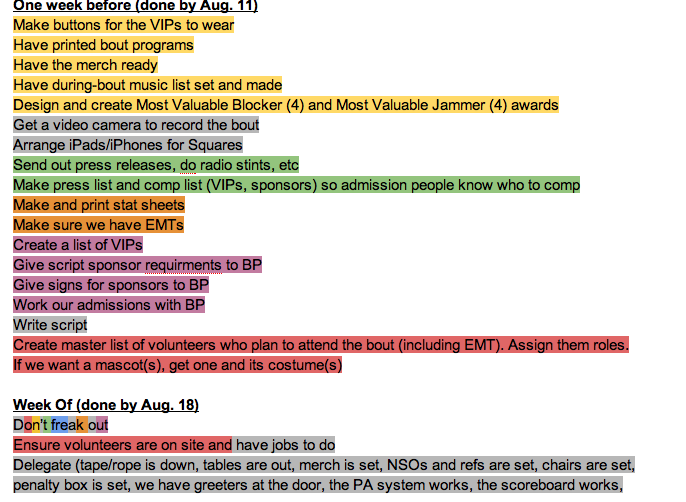
Delegation: BP’s primary responsibility (according to me … talk to your league) is delegation. Your league is full of busy people. If you plan to assign these busy people tasks, they will need ample notice of their responsibilities. So your first duty is to make a bout master list. I hope you like color-coding. To make a bout master list, title it with the bout date. Then make headers for the due dates. I started with 6 weeks out, then 5, 4, 3, 2, week before, three days before, day before, day of deadlines. (Bored yet?) OK, then fill in things you need done. Once you’ve done that, add each committee name to the top of the document and pick a color for it. Put it in that color and then put all the tasks in the correct colors. Here is an example of a bout master list I made.  (<That is probably the most valuable piece of information on this page.) Once you have the master list and share it with everyone on the league, make sure you have someone on your committee who is dedicated to asking the committee heads where they’re at and what they have accomplished each week. This person should also send reminders of what deadlines are upcoming to each committee. One email a week would do it, “Hey training, How are you? Just wondering if you finished task A, B, C. I also wanted to remind you tasks D, E and F are coming up. Thank you!” or the like.
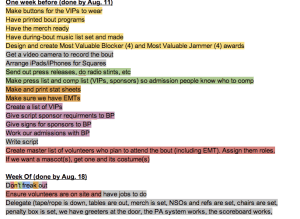
An example of a color-coded Bout Master List. (See link for full details)

That’s most of what BP is: organizing and delegating. Until the day of. More on that later.

Tape/rope: My league had to work in certain perimeters and certain budgets. We bought one rope and it lasted all season and I would bet it would last at least four more seasons, maybe longer. It was 1/4-inch yellow polypro rope and it was $20 for 400ft. You will need about 400 feet of rope that’s between 1/2 and 2 inches, as outlined by WFTDA. Tape was more difficult because our venue put some restrictions on us. We settled on buying blue, 2-inch-wide painters tape. Your tape will need to be 1-3-inches wide and a color that contrasts your floor. The cheapest place I found this was at Home Depot, sold in 6-packs. Painters tape comes in 60-yard rolls. Unlike the 400 feet of rope, you need at least double that (for laying below and above the rope) plus even more for fix-ups, so the 1,080-feet of tape from the 6-pack should be enough, but frankly, you can never have enough tape. Just save your receipts so you can return it — or use it for your next bout. Painter’s tape is NOT my first choice of tape. It rips. One time we did not properly stomp it down and in warm-ups on bout day we ripped up half the track by accident.
On one occasion, we held a double-header and knew painters tape would not cut it, and we got permission to use the coveted gaffers. Gaffers tape is the best. It’s cloth-like. It holds up a billion times better than painters, but doesn’t have the guckiness of ducttape. I bought mine in red from the Good Buy Guys (they don’t pay me to say that) because they were the cheapest. I got my tape a couple days later. I wanted to save my league money, so we taped down the first round (under the rope) with painter’s tape, then we put the rope down and then topped it with the more expensive gaffers tape.  If you get 2-inch gaffers, you will need three rolls (if they’re 55-yards), assuming you do the painters>rope>gaffers setup. It will set you back about $45 plus shipping and plus about three rolls of painters tape. Tape is expensive. It was my biggest expense for BP by far.
Lastly, you need some other-color tape (not the same color as your track boundary) for the jammer line, the pivot line and the 10-foot lines. You also want more tape for the 10-foot boundary required by WFTDA.

Shopping list: 400 feet rope (1/2 inch), 800+ feet of 1-3-inch-wide tape for track boundary, other-color tape for jammer/pivot/10-foot lines, other tape for 10-foot boundary.

Enough about tape? Yeah, you’ll be a tape ninja when you’re done. But remember what I said? All you really need is rope and tape. One last item though, I told my league’s sponsorship committee that tape was costing us about $100 and they found a local tree-trunk-grinding service to sponsor it, in full! They got a couple shout outs from the announcer at the bout.

Track set up: I’m not going to write about track layout. WFTDA gives comprehensive instructions and a hundred other blogs have already written about this. Just Google it. I don’t have any track layout magic for you. Just have lots of chalk and at least a 100-foot-measuring tape.
One thing to consider as a BP member though, is the set up of the track in relation to your venue. What setup will allow the most people to get a great view? What setup will be safest for referees? What will be easiest for the skaters? Where will “vendor village” be and how will people travel to the “village” and to their seat? Should you make foot traffic move around vendor village, the track, in front of other audience members? How does it relate to lighting? To the announcer?
People like sitting right behind skaters, if safe and if possible. Skaters like sitting right in front of the pivot and jammer lines (and WFTDA recommends you put team benches close to those lines) and to the penalty box. Skaters like to see the penalty board. Refs like 10-foot boundaries (usually) even when a 5-foot boundary would do, by WFTDA rules. Refs like to see NSOs and NSOs like to see the score keeper. You need to account for all of these things, plus traffic flow to the bathrooms, concessions and parking lot. Talk about this a lot beforehand with BP and make drawings, take measurements of your space, try things out.

Train: One thing guaranteed to make bout day easier is having your whole committee knowledgeable on all the “this can go wrong” stuff. Everyone on BP (assuming it’s a small committee) should know how the sound system, lights and scoreboard works. Ideally, your league will have a HR sort of committee that will organize and train volunteers ahead of time, but it’s nice to have several knowledgeable people available when things hit the fan. Of course, your volunteers should know the lighting plan, your NSOs should know how to use the scoreboard, your announcer should know how to use the microphone and your DJ should know how the music works, but BP needs to know how the microphone and the music interact. You need to know how the lighting interacts with the script/announcer, etc. Do a “dress rehearsal.”

Plan: Make sure to send the day of schedule to the other team and to your team with plenty of notice, and then let other committees know how things break down on the big day. Of course, other committees can refer to the Bout Day Master Plan, but it’s nice to reaffirm with an hour-by-hour plan, if possible. For instance, when should sponsorship hang the banners and where? When can refs warm up? When will the announcer have to do a run-through of the sound system? When do you need volunteers to set up admissions table? When do they need to staff those tables? Etc. Getting everyone on the same page and same schedule is immensely helpful. People are usually giving of their time, so long as you don’t waste it. Having a list of tasks that need to be completed helps with that.

Sleep well the night before. If possible. Don’t freak out. If you’re prone to freaking out: 1. Don’t 2. Keep paper and pen by your bed so you can write down the last-minute tasks you must do that you’re having nightmares about.

— Bout day —

Preparation: Don’t freak out. On bout day, if you are the one everyone is looking to, you need to be the calmest and the most collected. Bring enough food to get you through until late (like after-party late). I like to keep my Dash[clip]board with me with lots of pens, paper and some money. Wear something that stands out, like something with your name on the back and a colorful flourish, so people can say, “Yes, Dash is over there with the gold headband and yellow neckerchief” to aimless (no!) volunteers. Wear something with pockets. Don’t freak out. If you start to get overwhelmed, write down the tasks that need to be completed on your clipboard and begin delegating them. This is not the time to be a control freak, this is the time to rely on your leaguemates who are smart women too. And volunteers.

Admissions: You and your team should have a plan in place. Your BP team should also be ready to have your plan fail and be ready to make last-minute changes and decisions. For instance, at the first bout my last league did, we thought we could contain our admission to one table and three volunteers (one for cash sales, one for credit cards, one for counting heads. Sponsorship committee sent another volunteer to meet VIPs). We thought we’d have 200 or so guests. When 2,000 lined up out the door, out the parking lot and down the street, we had to adjust our plan. We added another table and three more volunteers. At the following bouts we had three tables (advanced sales, buy them now sales, VIP) and each had two volunteers, plus two (total) headcounters = 8, plus a volunteer wrangler. Two of those volunteers were trained on Square, a free device that takes credit cards by just using your iphone or ipad (they don’t pay me to say nice things either). Square takes 2.75% of your sale, so on a $5 ticket, you actually reap about $4.86. It’s about a $7 loss for every 50 tickets sold. For my league, that was worth it — maybe you lose two customers ($10) because they didn’t bring their cash and an ATM is too far away.
Another great tools for pre-sales was Brown Paper Tickets (no one is paying me for anything, to be clear). They have the ability to put their fees onto the customer, so your league reaps all the cash. It means online buyers pay about $1.80 more per ticket. They give you a “will call” list that you print out and keep at the door. I suggest doing this early in the day and editing it down to just names (not addresses, ticket numbers, yadda yadda).
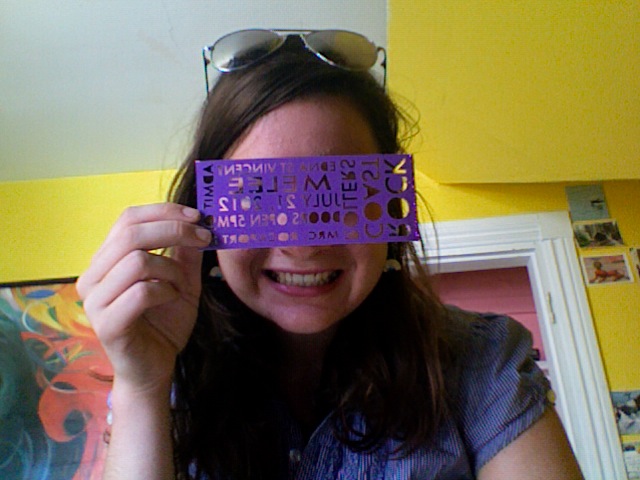
Lastly, we utilized the skills of one of our derby girls who is an artist to make tickets. She would make 300 for each event and we would sell them at local retailers. We KNEW this would be a money-spender, not a money-maker, but it got local businesses involved, got a lot of talk going in the community, increased our visibility AND, an added perk was that they were such beautiful tickets, some people bought them just to have them. We sold extras as keepsakes at the merch table on bout day. Here is a picture of a ticket example (it was a purple cutout and had purple glitter on one edge): 

An assortment of tickets for one bout. The artist (Yellow Bird & Co) made lots of colors for this one bout. People loved it and requested certain colors.

Announcers and the script: Starting with announcers: If you have one, great. If you don’t, the best option would be a trained announcer. The Association of Flat Track Derby Announcers has a list of them. If that doesn’t work, try looking for potential talent from other sports in your area. Try the local theater. Try open mic nights (comedians can make great announcers so long as they know your league’s expectations: is your bout family friendly? Do you want him/her to joke about sexy ladies hitting each other or for the announcer to be an ambassador of derby as a sport? Etc.). Ask your league if they know someone who would be good. If it’s a new person, my old league found it was helpful to 1. Train the new announcer at scrimmage practices 2. Pair the new announcer with a non-skating player at the bout. For instance, if you have a knowledgeable player who is out on an injury  — and if she can agree to call the bout fairly and not “coach” it over the microphone — this could add strategy knowledge to your announcing.
The script is a lot like an outline. It has a list of sponsor shoutouts with the correct information, the team rosters with names and numbers, sample wording for the “how derby is played” demo (if necessary — depends on announcer’s experience), wording about the halftime shows, wording about the league and future events. It’s helpful to have the mandatory shoutouts and the rosters on separate pages for the announcer(s) to quickly flip to. Talk to your announcer about what s/he wants from you.

Halftime: I’m not going to spend much time on this because you can find helpful tips on this elsewhere. But here are some tips: Halftime shows keep people. They keep them entertained, sitting, eating, consuming, watching derby. They’re important. They’re important for another reason: ticket sales. When thinking about what to book, like “should I book a fire juggler or a 50-person dance ensemble?” think about entertainment first, but then think about “what sort of draw will this halftime show have?” If you book the juggler, people will be in awe and talk about the show, but if you book a 50-person dance ensemble, you might have 50 sets of parents (100) buying tickets ($500 by our $5 ticket price) and those parents then talk about derby at their workplaces and we spread the roller derby virus further, deeper … MWA HA HA.
*Breaths deeply*  Make sure to comp the actual performers who do your shows and make sure you have the wording they would like your announcer to use.
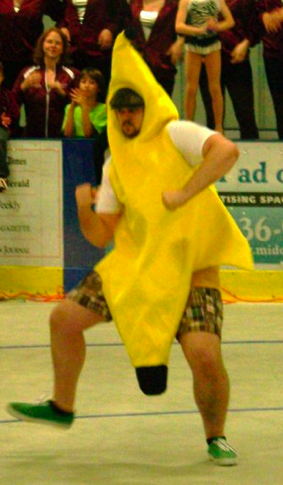
If you’re strapped and just don’t have a halftime show, there is an easy way to make one: Use your announcer. My last league had a mascot (a bananasuit borrowed from a local nonprofit — no, my league wasn’t “The Bananas” but kids liked it and it was free, so we used it.), so when one halftime show went a bit awry (sound system issues — try all CDs in your soundsystem first!) BP quickly invented “the banana race” which is when the announcer told every kid in the audience to come to the track and on 1 … 2… 3… chase the banana around the track! It’s entertaining, easy, free. You could also do “push the derby girl” race with three of your derby skaters in a squat while kids push her around the track. Etc.
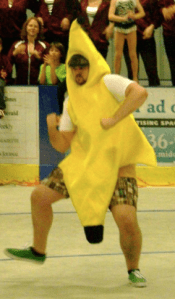
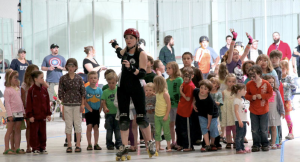
I once led the “banana race.”

Clean up: Your audience is made of cool people. We know this because they like derby. So, make sure your announcer asks the audience for help cleaning up after the bout. The basics: throw out trash and help rip up the track (if necessary). People can be super good about this. To help them be super good about this, make sure there are lots of trash cans around the venue so people feel it’s easy to clean up after themselves. Have them by the exits and near major walkways.
My old league had a “nobody goes to the afterparty until the venue is spotless” rule — and I think it’s a solid rule. Each leaguemate had to “check out” with a BP person to make sure there was no more work to be done. If you are the BP manager, you stay last and do a final walkthrough and make sure everything is sparkling. By leaving a place better than you found it, you’re more likely to be invited back. But you knew that.

Extra tips:

  • Contact your local churches and schools to see if you can borrow tables (admissions, for volunteers to eat pizza, for the vendors, etc) and chairs (for handicap seating, VIP seating, vendors, penalty box and benches, etc) free.
  • Local farms that grow garlic often have large, industrial fans to dry the bulbs. These feel nice and breezy on the bench. Send a few emails to see if your league can borrow one for bout night. Always offer tickets in exchange for favors; it’s just polite and gets more derby buzz going in the community.
  • Like the “pull in more ticket sales by having a halftime show” you can do the same with the national anthem. If you have the local high school choir (25 kids?) sing the anthem, you might reap 50 ticket sales from their parents who want to hear them sing. Try to involve as many people in the bout as possible.
  • If your bout is family friendly, make it family friendly. Maybe get a local facepainter to hang out in vendor village. Or a hula hoop maker. One $2 solution is to go to Goodwill and buy a Twister board. Put it in vendor village and leave it there. Kids will play. And parents will shop in your sponsor village. Win win!

Epitaph: This isn’t a complete list. This isn’t a “do this, don’t do that” guide. You have to do what works for you, your committee, your league, your audience, your venue and your community. So do that. Do what feels right. But above all else, remember: You do derby because it’s fun. Your fellow leaguemates bout because it’s fun. That’s why they help with bouts. Volunteers help because derby is fun and because they want to be part of this world. Be nice to everyone and thankful and make sure that people who just want the inclusion of being in this world get that. Have fun. Relax. Make it fun. Chill out. DON’T FREAK OUT. Ever. (And if you have questions, leave them in the comment section and I’ll answer them, or maybe someone more knowledgeable than I am will answer you.) Luck!

Happy bouting!